


In the middle of a heat wave in the city of Hoofddorp, in the vicinity of the aviation JunkSpace of Schiphol Airport, I ambled into Kinepolis to watch Christopher Nolan’s The Odyssey. This complex was different from the kinds I had once known in the US, which sprawled out horizontally, surrounded by acres of parking lot pavement. Instead, nestled into the heart of the city centre, it extended vertically onto several floors, halls connected to a labyrinth of stairs like an MC Escher drawing. But like the American theatres, at least, the space was filled with a familiar sound object: American country music played through tinny, unlocatable speakers. The air inside was warm, greenhouse-like; this was not unexpected – Kinepolis’s website warned its visitors that the AC was broken in this particular location that day, and the sun-facing windows which stretched across all the floors only amplified the heat.
Up two flights of bifurcating stairs, some leading visitors astray even further up into other halls, the screening was in Hall 3. Half a dozen people gathered outside the door, water bottles in hand, until an employee came. ‘Jullie kunnen gewoon binnengaan, het is al open!’ They only left the door closed to keep it cool. With some murmuring, the small group got up and entered the darkness of the theatre hall. Cool air brushed against my face; I was reminded of the breeze that escapes a refrigerator door, kept shut to preserve food in a power outage. I took a seat in the back in one of the comfort chairs – loveseats usually shared by couples, partitionable with an armrest. The few viewers shuffled in and scattered about a row or two in front of me. The rest of the hall remained empty. The room was small, especially for a major international cinema chain like Kinepolis, far short of the splendour of an IMAX hall.
Space
The Odyssey is about control, of which containment – deciding what is included and what is excluded – is one type. Not only is containment one of the main themes explored through the work, referenced through its exploration of hospitality (xenia, referred to simply as ‘Zeus’s law’ in the film), it is itself reproduced across its production and distribution. To even call it a film is an attempt to contain and regulate its experience; better terms may be spectacle, phenomenon or event. The spectacle of The Odyssey begins before taking a seat in the film hall, before entering through its doors, before even walking into the complex to buy a ticket. This spectacle is initiated external to the film-viewing event altogether in the internet’s hyper-dimensional tubes of rhizomic distribution that construct the spectacle. Willingly or not, as beings-on-the-internet, we are all exposed to The Odyssey. As an ambient phenomenon, it is a virus that breaks through the membranes of your subconscious. The glance of discourse on costumes, of a notification on Instagram tantalising you with half a post about narrative inaccuracies, which you can read the entirety of by downloading Threads, and you are infected.
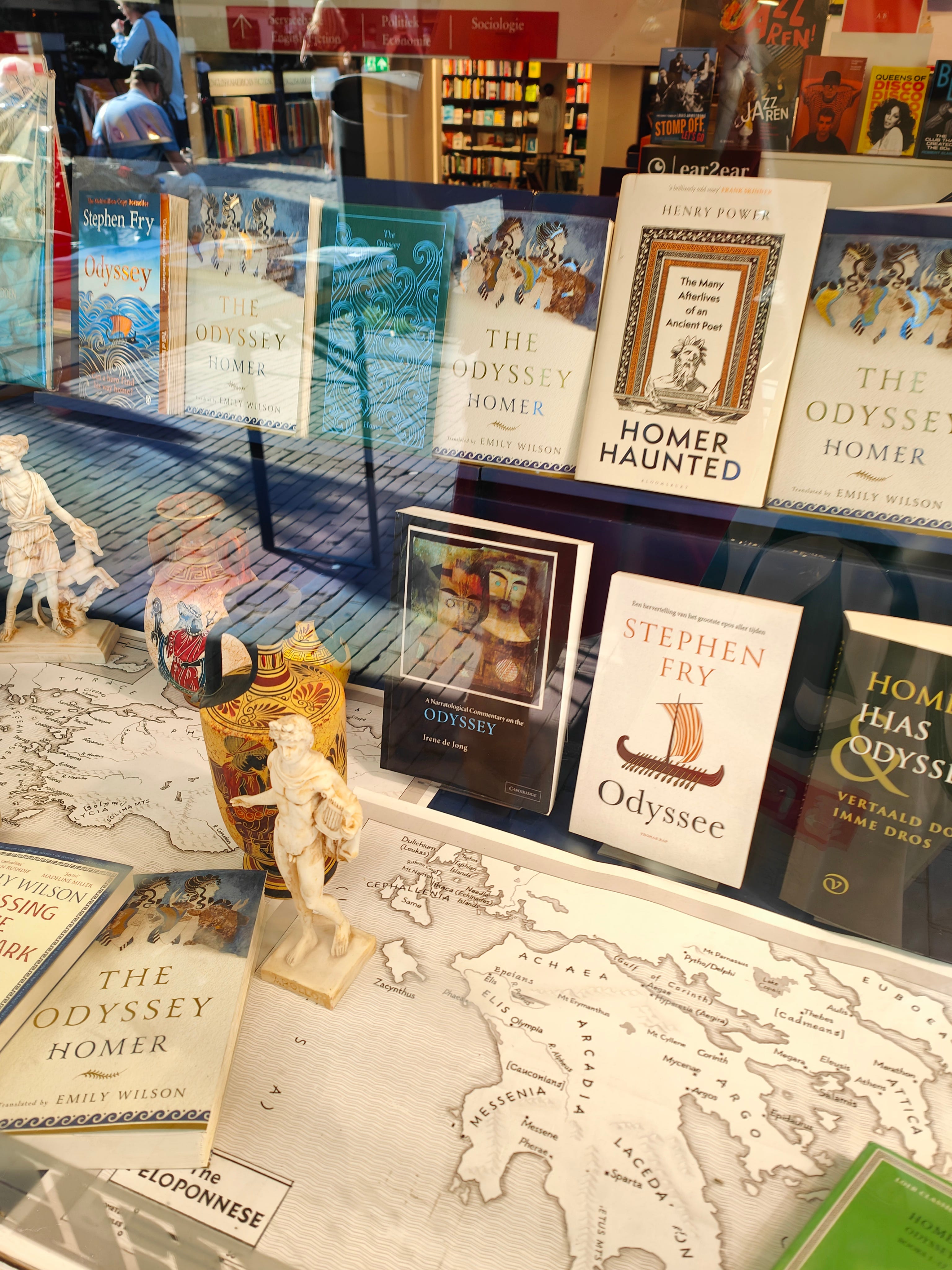
Through this mechanism, The Odyssey asserts itself as an uncontainable presence. The phenomenon demands to be experienced. Memes appear; thousands of discursive blog posts about translations and casting, trending bars on Twitter, news articles on Google all collude to hype up the event. The phenomenon reconfigures the fabric of material reality itself. A stroll in any city street or airport alike, past any bookstore – new or secondhand – reinforces the sense that The Odyssey is unavoidable. Bookstores have long ceased to sell books; they are now are filled with ‘logged on’ paraphernalia like capybaras, Funko Pops, black cat objects, and expensive Japanese stationery (and kawaii-inspired stationery, like Legami Milano). They interpellate you into the consumer persona of the shy, bookish reader and their particular interests. Meanwhile, the algorithm has deterritorialised the very shelves of bookstores, now with shelves laid out to capture the attention of BookTok, Substack and Goodreads; the stores sometimes even sell blind boxes of volumes identified only by a Goodreads score, their titles obscured by paper wrapping. In such occasions when the general public is reminded of the existence of the ancient technologies of codices and printed word, such as this occasion with The Odyssey – one of the Western canon’s most influential works – bookstores rush to restructure their physical space both to anticipate and influence the influx of foot-traffic. The Athenaeum bookstore in Amsterdam has rearranged its front display to include several large maps of Ancient Greece along with assorted translations and versions of the book, as if to invite passers-by to engage with the event. This arrangement is recreated in fractally smaller scales inside the store: a stand with different translations of the Odyssey, a Greek section, and so on.
Medium
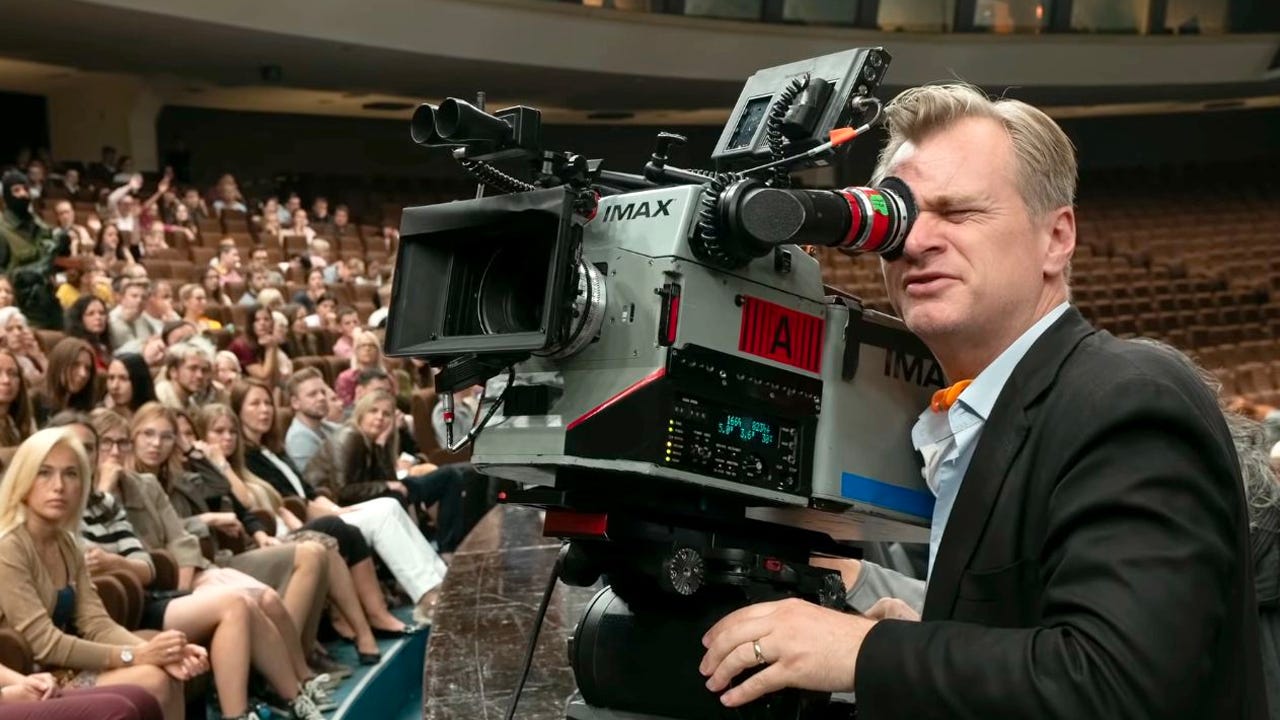
If you are in Europe, you will likely never experience the film as Nolan wanted you to. You are not once permitted to forget that Nolan painstakingly shot on expensive 65 mm 15-perforation IMAX film, from start to finish, composing everything in its 1.43:1 aspect ratio. Nolan has breathed life into every frame of this film; he has inspired it. Even if the film had been overseen by Nolan to accommodate multiple distribution formats, the exclusivity of the IMAX presentation precedes all these alternatives. The viewing of the film in all of its 70 mm IMAX glory is the event. As exemplified by the outpouring of memes coinciding with its release, where The Odyssey is envisioned through increasingly obscure or degenerated media (both in viewing and in production), the event can only truly be experienced through absolute conditions satisfied by 41 theatres in the world, only three of which are in Continental Europe. This scarcity simply reinforces the film as a spectacle; watching The Odyssey on one of these regular screens is tantamount to committing an atrocity, a disgrace to the cinematic experience.
While films are generally screened in cinemas for a limited time (a temporal constraint), the distribution of this film then imposes an additional spatial constraint. Films today are viewed on a variety of mediums and devices with varying levels of theatre-likeness: projectors, television, computer screens, laptops, tablets, smartphones, Nintendo Switch. This often runs contrary to the intentions of the director, where the work is generally intended to be experienced on the silver screen in the dark room of the theatre hall. David Lynch once objected to watching films on mobile phones, saying, ‘it’s such a sadness that you think you’ve seen a film on your fucking telephone. Get real’. At a time when many places in the world are experiencing the closing of local theatres and under financial pressure, which already creates the scarcity of viewing a film in a hall, the use of 70 mm IMAX technology further restricts the possibilities of viewing. The asymmetric global distribution of IMAX technology stratifies the viewing of The Odyssey into a cartography of Nolan-faithfulness, one which is remarkably Anglo-centric: beyond North America, the UK, and Australia, where the bulk of 15/70 IMAX screens exist, the only other theatres with this technology are in Belgium, France and the Czech Republic. The austerity of the film’s projection has effectively contained its potential viewership into geography. The vast majority of potential viewers are forced to make a pilgrimage, if not across several countries, then into entirely different continents. Hoofddorp and indeed the whole of the Netherlands are some of the places misfortunate enough to be deprived of The Odyssey’s full glory.
The consumer-spectator remarks that the IMAX, with its towering screen that spans the entire field of human vision, allows a sort of full immersion, a totality of embodied experience. Cinema is already a medium which displaces the individual viewer from their own phenomenological existence into one shared by all the viewers in the room and even elsewhere. As Bernard Stiegler observes, this occurs through a merging of the time flow of consciousness with that of a ‘temporal object’ (i.e. the film). He writes,
You arrive at the beginning of the film and you have a toothache; you feel on arrival that you have a pain in this tooth – and then as you enter the film, you forget your tooth. … [as] the film develops, as you enter into the film, taking up and adopting the time of its flow, you cease to think of your […] tooth. You are no longer in the seat, and your tooth is no longer in your mouth, or, rather, you are no longer in your body: you are in the screen. You are in the screen because you have adopted the time of the film.
As anyone who has ever scrolled short form video feeds on a phone may intimately know, it does not take a massive screen to create viewer entrancement. The question of the 15/70 IMAX medium is about optimising the experience and therefore to contain anything that could possibly intervene – including the artefacts of the medium itself. With such a large recording surface, the film is clean, neutral, devoid of any contaminants, absorbing the spectator’s gaze into total presence in the film, crisp like the taste of pure H2O. This conflict, of content and texture, suggests that a particular uncontaminated viewing experience precedes the medium, whose attributes intervene on the purity of the medium. The medium is therefore at a perpetual battle with itself. We can point to Brian Eno’s quote, which has through its constant citation become a cliché in the discussion of media and its artefacts:
Whatever you now find weird, ugly, uncomfortable and nasty about a new medium will surely become its signature. CD distortion, the jitteriness of digital video, the crap sound of 8-bit - all these will be cherished and emulated as soon as they can be avoided. It’s the sound of failure: so much of modern art is the sound of things going out of control, of a medium pushing to its limits and breaking apart. […] The excitement of grainy film, of bleached-out black and white, is the excitement of witnessing events too momentous for the medium assigned to record them.
In short, Eno points to the dialectic of the medium, whose failure to capture the purity of vision, becomes what defines it, particularly in its absence. Cinema technology, through a continuous advance of resolutive progress, has now displaced 8 mm, 16 mm and 35 mm films, miniDV cameras, digicam footage, phone footage, not by barring them outright through technological progress, but by marginalising them into particular affects. They have become signifiers. Rather than allowing the chaos of the medium, we now have 8 mm vacation footage, 16 mm punk videos, miniDV found footage, etc. These lesser formats, through their signature artefacts, seemingly prevent viewing from being the pure phenomenological experience of narrative (and thus life), and it is this that IMAX promises and this that Nolan demands that you experience.
The hyper-resolution of The Odyssey’s 65 mm 15-perf IMAX film captures a crucial visual motif of the film: particles. The film is filled with particles, such as dust and rain, which float around, captured with such effortless detail, emerging from the apparent texture(lessness) of the stock on which the film is shot. Such particles become the main character of The Odyssey. These particles exist in absence of what the medium attempts to suppress: noise and grain.
In our experience of everyday life, our eyes and optical apparatuses are constantly processing input and filtering it into visual signal. The visual field is hardly ever clean; rather it is continuously updated and corrected. Sometimes, if we focus hard enough, we may observe particles of dust that float around us, which are otherwise imperceptible. We take dust for granted – it is spatially noise. Dust in this sense is unwanted: it intervenes in scanning and clings to electronic displays, degrading the appearance. The processes of cleaning and the development of cleaning technologies allow for greater control of dust. Vacuum cleaners and static brushes exist to mitigate dust. The irony then, of the photographic medium which has prioritised resolution so much is that dust itself, the ‘weird, ugly, uncomfortable and nasty’ presence of physical space, becomes the sign of superior resolution. It is now so clear that we can even see dust!

Through this decision to shoot on such a film stock, the cinematographer enacts a trade: noise and grain are displaced into particle artefacts. But this is okay – the particles exist in the film’s world, in the diegesis. As Joker says in The Dark Knight (2007), ‘Nobody panics when things go according to plan […] because it’s all part of the plan’. It becomes another surface for control; the ascension of resolution to hyper-resolution is not about removing noise but, to borrow the term from Gilbert Simondon (via Gilles Deleuze), modulating it. The relationship with the medium becomes a managerial relationship. No wonder that artificial noise is added to Acrylic elements in Windows 11 Fluent Design, which would otherwise make high resolution displays appear too clean. No wonder that a photographer whose camera captures so much detail often adds grain after the fact, as a textural layer. Those afraid of noise eventually encounter its inversion: horror vacui. Something can be so sterile that one has to add noise back in. It is never about reducing noise but control – about making new kinds of acceptable, modulatable, controllable noise. Noise is in a permanent dialogue with signal and, for total control, noise itself must be sorted into good and bad. (This is to say little of the other discontinuities that Nolan has inadvertently created through this displacement, such as the widely discussed complaints about missed focus. There is no beyond-the-noise.)
Citation
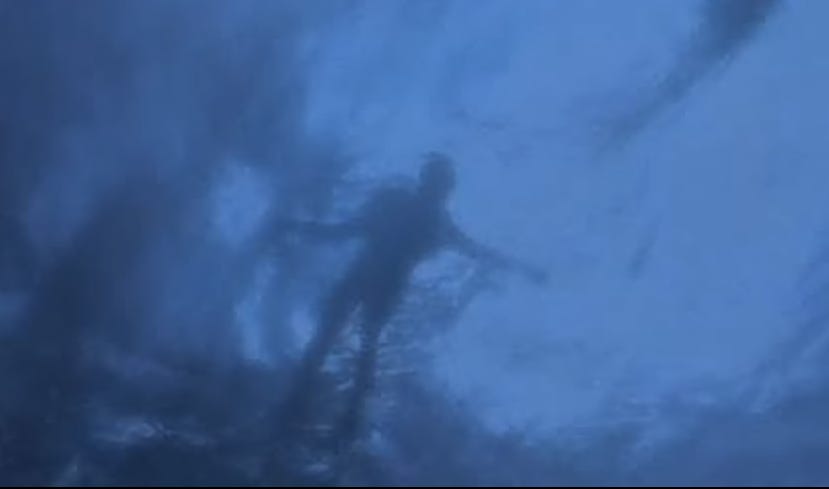
If Nolan is to be regarded as part of a generation, he stands out from the hyper-citation pastiche mechanics of his brethren such as Paul Thomas Anderson, Quentin Tarantino, Darren Aronofsky, David Fincher, or Wes Anderson. His work appears virtually sterilised of this sort of cineaste intertextuality; in wake of this self-sterilisation is a prodigious self-citation engine that courses throughout his work.
Homeric poems are the products of oral tradition and themselves have disputable authorship. Whether Homer is one or several individuals, there is no questioning that the film’s authorship is conspicuously consolidated around Nolan, the auteur. Many have hypothesised that all films of Nolan may be sub-worlds of Inception, figures washed on shore, troubled by obscure sorrows. Such interpreters are in no way kept at bay by The Odyssey, whose frame story concerns an amnesiac Odysseus (Matt Damon) who appears one day, on the shore of an island. His fugue of forgetfulness comes from magic lotus served to him by Calypso (Charlize Theron). The lotus flowers are the opposite of Proustian madeleines; they suppress memory, and he consumes them with excitement, too troubled by the horrors of his journey. But now he slowly begins to recall his past and what he must do, memories which unfold in front of us throughout the first two acts of the film.
The casting of Matt Damon, of course, is first loaded beyond Nolan’s control. Damon, who has played stranded survivors (Gerry, The Martian), amnesiacs in a fugue (The Bourne Identity), infiltrators (The Bourne Identity, The Departed, Talented Mr. Ripley), etc. makes it impossible for Nolan to suppress the intertext. But even beyond this, the traces of his other work appear spasmodically, even jarringly. Helen of Troy (Lupita Nyong’o) has her own Two-Face-esque reveal (‘The face that launched a thousand ships – or should I say 500?’); the gritty inglorious existence (‘of piss and shit’) inside the Trojan Horse recalls at once the water tanks in The Prestige and the tense belly of the twin ships, strapped with bombs and equipped with each other’s detonators, in The Dark Knight. In a Nolan-invented subplot, Sinon (Elliot Page) and Antinous (Robert Pattinson) engage in a swap that recalls that of the twins in The Prestige. Odysseus’s return recalls both that of Batman in The Dark Knight, appearing to fight off his imitators, and Gordon’s return from the dead. This is one of the central ironies of the work – an irony of Nolan’s work in general, which at once appears to mourn a death of the centre, of truth, but at the same time is unable to suppress it. Nolan cannot help but produce The Odyssey as anything but a work filled with all of his pre-occupations.
Just as his The Odyssey draws from a composite tradition, it also draws from a Nolanic tradition. The Odyssey is Nolan-branded to its fullest extent, a machinic delivery of unfiltered Nolanness, bigger, longer and uncut, in full overdrive Nolan-production. In this sense, of pushing his branded authorial vision to its recursive excesses, he is little different from Wes Anderson. But where Wes Anderson controls and aestheticises media, often in betrayal of commonly accepted industrial standards (his DP Robert Yeoman relayed concern about softness in the vintage Cooke lenses that Wes Anderson preferred in 1960s scenes in Grand Budapest Hotel), Nolan cannot banish noise from his work in the arms race of technological perfection, nor can he banish pastiche from his own work. Through his own obsession with noise and pastiche, he is his own pastiche. Nothing says this better than Helen of Troy, whose face is unwounded in classical interpretations, now cartoonishly transformed into Two-Face, as if Nolan cannot help but taint his work. The plight of his protagonists – who must banish evil, chaos, corruption, guilt, and pain – is recreated in Nolan’s own plight with the medium.
Narrative

Apart from battling the medium, The Odyssey is extensively about containers: the ethics of containment, who gets excluded, who gets included, and what happens when containers are breached. Troy, as a city-state, is a container encased in a wall, impenetrable only until the Trojan Horse is brought to them. The horse itself is a container, a space which traps the soldiers that intend to invade. The ship, which houses Odysseus’s crew, is a container on the brink of collapse, constantly requiring the sailors to seek supplies. The suitors that show up in the palace in Ithaca are also occupying a container, guarded closely by Penelope.
The Cyclops and Circe are conspicuously now portrayed, not as living in communities, but as living alone. The Cyclops’s solitude, unlike the Homeric portrayal where he lives in an atomicised society of cyclopses, leads the crew to conclude that he is beyond human language. Circe likewise prefers to be alone, punishing intruders by turning them into animals, even confronting Odysseus for invading her privacy. Nolan’s Odyssey recasts these interactions in profoundly contemporary terms: the breaching of the hyper-individual’s bubble.
Odysseus’s most virtuous quality is ‘self-control’ – the film’s three-hour runtime repeatedly shows how he is able to withstand anything that would lead him astray from his goal of returning home. Despite all of his will, he cannot intervene in his men’s paths towards their doom; he cannot control them. He only succumbs to temptation when he is finally by himself, spending seven years with Calypso. The film, then, stages one of the central contradictions and greatest fears of the current age: the omnipresent allure to retreat into consumer bubbles in the warm comfort of the algorithmic void, the very spaces in which, ironically, the film is first encountered.
This is what is curious about The Odyssey, a film which cannot resolve its own contradictions; a film concerned with the politics of invasions circulates invasively through algorithms, modulating physical space; a film which is concerned with control and containment but whose technical standards constrain its own viewership. Whether it sets out to do all of this is beside the point – it cannot help but be its own victim.
The final credit scrolls past, and then as the overhead lights brighten, the air is filled with the tinny recording of country music once more, the drawl a signifier of a land in the West, on the other side of the ocean.
References
Atad, Corey. “‘The Odyssey’ Was Made for IMAX 70mm. Good Luck Watching It That Way.” Wired, July 25, 2026. https://www.wired.com/story/the-odyssey-was-made-for-imax-70mm-good-luck-watching-it-that-way.
Balling, Gitte, and Marianne Martens. “‘BookTok Helped Us Sell It’: How TikTok Disrupts Publishing and Fuels the #Romantasy Boom.” Convergence: The International Journal of Research into New Media Technologies 32, no. 4 (2026): 1258–78. https://doi.org/10.1177/13548565241301271.
Cooke Optics. “Wes Anderson and Robert Yeoman ASC: Straight-Shooting Imagineers.” Accessed September 12, 2026. https://cookeoptics.com/news-and-events/wes-anderson-and-robert-yeoman-asc-straight-shooting-imagineers/.
Deleuze, Gilles. “Postscript on the Societies of Control.” October 59 (Winter 1992): 3–7.
Eno, Brian. A Year with Swollen Appendices: Brian Eno’s Diary. London: Faber and Faber, 1996.
Harris, Mike. “Some Call It Soft, I Call It Dreamy: Why Nolan’s The Odyssey Was a Focus Puller’s Nightmare.” Digital Camera World, July 30, 2026. https://www.digitalcameraworld.com/cameras/cinema-cameras/some-call-it-soft-i-call-it-dreamy-why-nolans-odyssey-was-a-focus-pullers-nightmare.
Homer. The Odyssey. Translated by Emily Wilson. New York: W. W. Norton, 2018.
Independent Cinema Office. “Capital Investment for Independent Film Exhibition—April 2025.” April 2025. https://www.independentcinemaoffice.org.uk/advice-support/capital-investment-for-independent-film-exhibition-april-2025/.
Janicek, Karel. “Prague’s Rare 70 mm IMAX Draws Thousands of Europeans for Nolan’s ‘The Odyssey.’” Associated Press, July 27, 2026. https://apnews.com/article/ad3d6aa02381b7253cb486231411a256.
Kodak. “Shooting Entirely on KODAK 65mm Film, DP Hoyte van Hoytema ASC NSC FSF Created a Visually-Thrilling Sensation for Christopher Nolan’s Box-Office Hit ‘The Odyssey.’” August 24, 2026. https://www.kodak.com/en/motion/blog-post/the-odyssey/.
Lynch, David. “Stories.” Bonus feature on Inland Empire. 2-disc DVD. Absurda/Ryko, 2007.
Microsoft. “Acrylic Material.” Microsoft Learn. Updated August 29, 2026. https://learn.microsoft.com/en-us/windows/apps/design/style/acrylic.
Nagy, Gregory. “Oral Traditions, Written Texts, and Questions of Authorship.” In The Greek Epic Cycle and Its Ancient Reception: A Companion, edited by Marco Fantuzzi and Christos Tsagalis, 59–77. Cambridge: Cambridge University Press, 2015. https://doi.org/10.1017/CBO9780511998409.004.
Nolan, Christopher, dir. The Odyssey. Universal Pictures, 2026. Film.
Simondon, Gilbert. Individuation in Light of Notions of Form and Information. Translated by Taylor Adkins. Minneapolis: University of Minnesota Press, 2020.
Stiegler, Bernard. Symbolic Misery, Volume 1: The Hyperindustrial Epoch. Translated by Barnaby Norman. Cambridge: Polity, 2014.
Wilson, Emily. Interview by Walter Isaacson. Amanpour. CNN, July 28, 2026. https://transcripts.cnn.com/show/ampr/date/2026-07-28/segment/01.